Apple Reportedly Eyes CXMT as AI Memory Boom Reshapes DRAM Supply Chain
Disclaimer: This article summarizes industry rumors, analyst commentary, and supply-chain speculation. None of the procurement plans, product specifications, pricing forecasts, or regulatory claims discussed below have been officially confirmed by Apple unless otherwise noted.
📈 AI Infrastructure Is Driving a New Memory Supply Crunch #
The rapid expansion of AI infrastructure is fundamentally reshaping the global memory industry.
As hyperscale cloud providers continue deploying AI clusters, memory manufacturers have increasingly shifted production capacity toward high-margin products such as High Bandwidth Memory (HBM), reducing the amount of conventional DRAM and NAND available for consumer devices.
According to multiple industry reports, this shift has tightened supply across the PC and smartphone markets, contributing to significant price increases for mainstream memory components throughout 2026.
If these trends continue, consumer electronics manufacturers may face sustained component cost inflation over the coming product cycles.
🍎 Rumor: Apple Could Be Exploring CXMT as an Additional Memory Supplier #
One of the latest supply-chain rumors suggests Apple may be evaluating China’s Changxin Memory Technologies (CXMT) as a potential DRAM supplier.
Some reports go further, claiming Apple is seeking regulatory approval that would allow procurement from the Chinese memory manufacturer in an effort to reduce sourcing costs and diversify its supply chain.
Apple has not publicly commented on these reports, and no official documentation has confirmed such plans.
If the rumors ultimately prove accurate, adding another qualified DRAM supplier could help Apple:
- Diversify its memory supply chain
- Reduce dependence on existing suppliers
- Improve procurement flexibility during periods of constrained supply
- Potentially lower component costs over the long term
At present, these remain speculative scenarios rather than confirmed business decisions.
🏭 The DRAM Market Remains Highly Concentrated #
Today’s DRAM industry continues to be dominated by three major manufacturers:
- Samsung
- SK hynix
- Micron Technology
These companies collectively account for the overwhelming majority of global DRAM production while also leading development of next-generation AI memory technologies, including HBM.
Because AI accelerators generate significantly higher margins than consumer memory products, manufacturers have increasingly prioritized enterprise-oriented production capacity.
Industry analysts believe this structural shift is one of the primary factors behind the ongoing price increases affecting smartphones, tablets, and PCs.
🚀 CXMT Continues Expanding Production Capacity #
Although still considerably smaller than the industry’s leading suppliers, CXMT has continued expanding its manufacturing footprint.
Recent analyst reports project that the company could significantly increase monthly wafer production over the next several years, potentially positioning it among the world’s largest DRAM manufacturers.
Some industry research firms have even suggested CXMT could become the fourth- or third-largest DRAM supplier if its expansion plans proceed as expected.
Separately, Changxin Technology Group recently advanced its IPO process in China, with proceeds expected to support additional manufacturing capacity and technology investment.
🔍 Mixed Reports Surround Google’s Interest #
Google has also been mentioned in recent supply-chain speculation involving CXMT.
Earlier reports claimed Google had discussed potential memory procurement with the Chinese manufacturer.
However, well-known Apple analyst Ming-Chi Kuo later stated that Google currently has no concrete procurement plans involving CXMT.
These reports are not necessarily contradictory.
Large technology companies frequently evaluate alternative suppliers years before any commercial agreement is finalized. Initial discussions or technical evaluations do not necessarily lead to production contracts.
🧠 AI Features Are Increasing Memory Requirements #
Another recurring rumor involves Apple’s future hardware roadmap.
Industry sources suggest Apple may increase memory capacity in upcoming iPhone generations to better support increasingly capable on-device AI workloads.
Among the rumored configurations are:
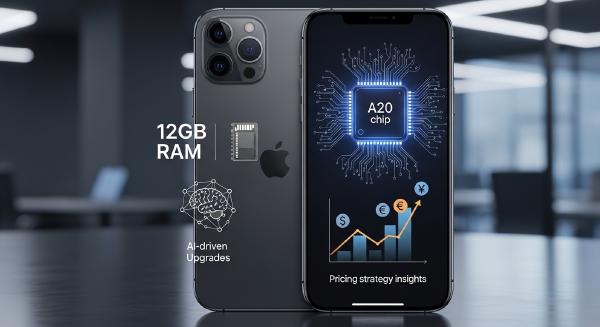
- Entry-level models increasing from 8 GB to 9 GB of RAM
- Premium models continuing to offer 12 GB of memory
- New memory package layouts designed to improve capacity utilization for Apple Intelligence
According to the speculation, future versions of iOS will rely more heavily on local AI inference, requiring additional system memory to support larger language models, multimodal processing, and enhanced Siri capabilities.
Apple has not confirmed any of these hardware specifications.
💰 Rising Memory Prices Could Pressure Future iPhone Pricing #
The increasing cost of memory components has become a recurring topic among supply-chain analysts.
Several reports suggest that DRAM and NAND pricing have risen substantially as AI infrastructure absorbs a growing share of global production capacity.
Industry estimates also point to rising costs associated with:
- Advanced 2 nm application processors
- Next-generation camera systems
- Expanded AI accelerators
- Higher-capacity DRAM packages
- Larger NAND storage configurations
Collectively, these components could significantly increase the bill of materials (BOM) for future flagship smartphones.
📱 Supply-Chain Estimates for the iPhone 18 Family #
Numerous investment banks and industry observers expect Apple to face increasing pricing pressure for its next-generation premium smartphones.
Forecasts vary considerably.
Some analysts believe Apple could largely absorb higher component costs through supply-chain optimization and internally developed silicon, resulting in relatively modest retail price increases.
Others project substantially larger increases if memory pricing remains elevated throughout the product cycle.
At this stage, all pricing estimates remain speculative, and Apple has announced no official pricing for future iPhone models.
🔮 Outlook #
The semiconductor industry is entering a period where AI infrastructure increasingly competes with consumer electronics for memory production capacity.
Whether Apple ultimately adds CXMT to its supplier ecosystem remains uncertain, and many of the reports currently circulating should be viewed as supply-chain speculation rather than confirmed corporate strategy.
Nevertheless, the broader industry trend is becoming increasingly clear: as AI workloads continue expanding, memory capacity, pricing, and supplier diversification are likely to become strategic considerations for nearly every major consumer electronics manufacturer.
Official announcements from Apple, DRAM manufacturers, and regulatory agencies will ultimately determine whether today’s rumors translate into tomorrow’s production decisions.