Apple’s Massive Autumn Lineup: HomePad, OLED iPad Mini, and More
Apple’s autumn product season may be far from over.
In previous years, September was the main event. New iPhones, Apple Watches, and AirPods would arrive one after another, effectively defining Apple’s annual hardware cycle.
This year could look very different.
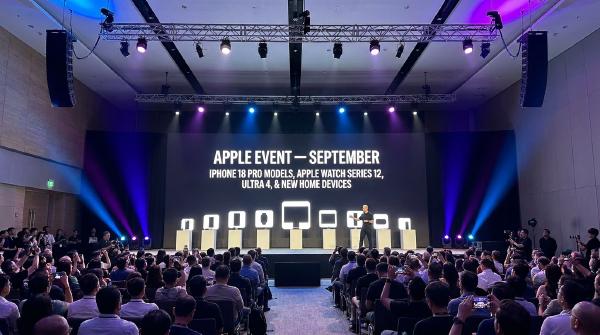
Reports point to a second wave of products arriving around October and November, potentially including a new HomePad smart display, updated HomePod mini, Apple TV, iPad mini 8, and even Apple’s long-rumored touchscreen MacBook.
The significance goes beyond the number of products. The lineup suggests Apple is expanding its hardware ecosystem into new categories while redesigning how its devices interact with users.
It also offers an early look at the priorities of new CEO John Ternus, whose engineering background appears to be influencing both product development and Apple’s internal organization.
🏠 Apple’s Smart Home Push Expands Beyond HomeKit #
Apple and LG are reportedly working together on a new range of smart home accessories, including video doorbells, smart locks, thermostats, temperature sensors, and several types of security cameras.
The important detail is that these products may not actually carry the Apple brand.
Instead, LG is expected to handle manufacturing and after-sales support, while Apple works closely on integration with its home ecosystem. The accessories are reportedly designed to work seamlessly with the upcoming HomePad, new HomePod mini, and Apple TV.
This approach would allow Apple to expand its smart home ecosystem without taking on every manufacturing, installation, and support challenge itself.
The strategy also has a precedent.
When Apple stepped away from producing its own external displays, it collaborated with LG on the UltraFine lineup. LG handled much of the hardware production while Apple helped ensure that the displays worked particularly well with Macs.
The same basic philosophy could now be applied to smart home hardware.
Matter, Thread, and UWB Build the Connectivity Layer #
Regulatory filings have already revealed some of the rumored LG accessories.
Several devices reportedly support a combination of:
| Technology | Potential role |
|---|---|
| Wi-Fi | Network connectivity and cloud services |
| Bluetooth | Local setup and device communication |
| Thread | Low-power smart home networking |
| Matter | Cross-platform smart home interoperability |
| UWB | Precise proximity detection and automatic unlocking |
UWB support is particularly interesting for smart locks. Combined with compatible Apple devices, it could enable automatic unlocking when an authorized user approaches the door.
But hardware integration is only part of the challenge.
Outdoor cameras have to survive weather. Smart locks need reliable installation and physical security. Doorbells require wiring or battery management. Customers need replacement parts, firmware support, troubleshooting, and repairs.
These are very different problems from designing a polished software interface.
By partnering with LG, Apple can potentially fill long-standing gaps in its smart home ecosystem while keeping its own focus on software, user experience, and system integration.
HomeKit has existed since 2014, yet competitors such as Ring and Nest have spent years building dedicated hardware around cameras and doorbells.
Apple’s challenge is no longer simply providing a good Home app. It needs a physical ecosystem capable of making that software useful.
Current reports point to Apple’s own smart home devices being unveiled around October, while LG’s related accessories could arrive several months later.
🖥️ HomePad Brings Siri AI Into the Living Room #
At the center of Apple’s smart home strategy is the long-rumored home hub, often referred to as HomePad.
Reports describe a roughly 6-inch square touchscreen designed for either tabletop placement or wall mounting.
The tabletop version is said to use a circular metal base with a support arm, creating a design reminiscent of the iMac G4.
Its functions would include:
- Smart home control
- Music playback
- FaceTime calls
- Calendar access
- Reminders
- Personalized household information
- Siri-based voice interaction
The hardware itself is not particularly revolutionary. Smart displays have been available for years.
The more important question is why someone would buy a HomePad instead of simply mounting an old iPad on the wall.
Apple’s answer appears to be context.
A Shared Screen Needs a Different Interface #
Leaked interaction concepts reportedly show a display that changes depending on how close the user is.
From a distance, the screen can present only essential information. As someone approaches, it can expose more detailed controls and interaction options.
The device may also recognize different family members and automatically switch to personalized calendars, reminders, and other information.
That distinction is important.
An iPad is fundamentally a personal computing device. A living-room hub is shared by an entire household.
That creates difficult privacy and interaction problems.
A personal iPhone can safely display a private notification because its owner is holding it. A shared display in the kitchen cannot assume that every person looking at it is authorized to see the same information.
Apple therefore needs the HomePad to understand not only what a user is asking, but also who is asking and where the interaction is taking place.
This is where the next generation of Siri becomes particularly important.
If Siri can identify the speaker, understand multi-step commands, resolve context, and reliably control multiple smart home devices, the HomePad could become much more than a touchscreen HomePod.
If it cannot, users may end up repeating “turn off the lights” three times while standing in front of the display.
That would be a difficult way to sell the future of AI-powered home computing.
💻 Touchscreen MacBook Could Finally Become Reality #
Apple may also be preparing one of its most controversial Mac changes in years: a touchscreen MacBook.
A recent macOS beta reportedly contains a small interaction change in which long-pressing an application icon in the Dock causes the icon to enlarge slightly, resembling the haptic interaction behavior found on iPhones and iPads.
That animation alone does not prove that a touchscreen Mac is coming.
But its appearance alongside other touchscreen-related rumors has naturally intensified speculation about Apple’s plans for macOS hardware.
Current reports point toward higher-end 14-inch and 16-inch notebooks, potentially retaining the MacBook Pro branding or eventually adopting the rumored MacBook Ultra name.
Several major changes have been associated with these machines:
- Touchscreen displays
- Tandem OLED technology
- Thinner chassis designs
- Reduced weight
- Dynamic Island-style display elements
- M5 Pro and M5 Max processors
For people who regularly carry large laptops, weight reduction could be particularly meaningful.
According to reports, Apple has rearranged internal components and reduced the size of certain parts to make the upcoming machines noticeably lighter.
For a 16-inch laptop, even a relatively modest reduction can make a meaningful difference during daily commuting and travel.
Touchscreen Support Creates a macOS Design Problem #
The hardware is only half of the challenge.
macOS was designed primarily around a mouse, trackpad, keyboard, and relatively precise pointer interaction.
Many menus, controls, and small interface elements are optimized for a cursor rather than a fingertip.
A touchscreen Mac therefore raises a fundamental design question:
Which interactions should happen directly on the display, and which should remain optimized for the keyboard and trackpad?
Apple cannot simply put a touch layer over macOS and call the problem solved.
It would need to decide when touch is useful, when a trackpad is better, and how the two interaction models should coexist without making either one worse.
If Apple gets that balance right, a touchscreen MacBook could become a meaningful expansion of the Mac platform rather than simply an iPad-like feature added to a laptop.
📱 iPad Mini 8 Could Finally Get OLED #
The iPad mini 8 is another rumored October highlight, and its biggest upgrade could be the display.
Current reports point toward an OLED panel, slimmer bezels, and a new-generation Apple silicon chip. The rumored configuration includes an A20 Pro, with memory potentially increasing from 8 GB to 12 GB.
The front camera could also move to a more natural landscape orientation for video calls.
For iPad mini users, however, the fundamental appeal of the product has never been raw specifications.
It is the size.
A compact tablet can be held comfortably in one hand, slipped into a smaller bag, and used in situations where a larger iPad feels excessive.
Choosing a smaller tablet should not mean accepting a dramatically worse display.
OLED Could Be the Upgrade Mini Users Actually Notice #
OLED would address one of the most visible limitations of previous iPad mini generations.
Compared with conventional LCD technology, OLED can provide deeper blacks, higher contrast, and more convincing dark-scene performance.
That matters particularly for a small tablet used for:
- Movies and streaming
- Reading at night
- Gaming
- Photo viewing
- Portable productivity
- Travel
Other rumored upgrades include an N1 connectivity chip supporting newer wireless standards, Apple’s in-house cellular modem on cellular versions, redesigned speakers, and an official IP-rated water-resistance capability.
The rumored speaker design could also move away from traditional visible speaker grilles toward a different acoustic driver architecture.
The combination would make the iPad mini 8 more than a routine processor refresh.
The question, as always, is price.
The current iPad mini starts at $599 in the United States. An OLED panel and additional hardware upgrades could push the entry price higher.
For users who specifically want a small premium tablet, however, that trade-off may be easier to justify than another modest annual chip upgrade.
🧭 John Ternus Is Moving Closer to Apple’s Products #
The hardware itself tells only part of the story.
The other significant development is happening inside Apple.
According to reports from Bloomberg’s Mark Gurman, CEO John Ternus has been spending substantially more time inside Apple’s design studios, visiting several times a week and sometimes appearing more than once in a single day.
That reportedly contrasts with Tim Cook’s much less frequent design-studio visits.
Ternus is said to be closely involved with both the Industrial Design and Human Interface teams.
While Molly Anderson and Steve Lemay continue to manage their respective groups, Ternus reportedly retains significant influence over major design decisions. Apple also is not currently looking for an external Chief Design Officer to sit above those organizations.
This reflects a broader organizational change.
Following several high-profile design departures, Apple is reportedly promoting younger designers while also recruiting externally to rebuild parts of the organization.
At the same time, responsibilities that previously occupied more of the CEO’s schedule are being delegated.
Financial responsibilities have moved further toward CFO Kevan Parekh, while supply-chain responsibilities are increasingly handled by Sabih Khan.
The resulting structure gives Ternus more room to focus directly on hardware, engineering, and product development.
🧩 An Engineering-Led Apple Could Change the Product Cycle #
Where a CEO spends time often reveals where the organization is placing its attention.
Ternus is reportedly interested in flattening management layers between engineers and senior leadership, encouraging more experimentation, and reducing Apple’s historical dependence on rigid spring and autumn launch windows.
The long-term objective would be a more continuous product-development and release cycle.
That does not mean the traditional September iPhone event disappears.
Instead, Apple could gradually become less dependent on two major annual launch windows and more comfortable introducing products when they are ready.
Such a transition would take time. Apple’s product-development processes have been refined over decades, and changing organizational structures at that scale cannot happen overnight.
More importantly, the upcoming autumn lineup itself cannot simply be attributed to Ternus.
Most of these products have been in development for years, long before he became CEO.
What Ternus can influence is how Apple handles the increasingly complicated interactions between products and teams.
The HomePad is a good example.
A device that recognizes family members requires cooperation between hardware, industrial design, software, machine learning, privacy, security, and human interface teams.
The camera may identify who is standing in front of the device, but another system must determine what information that person is allowed to see.
The assistant must understand the user’s intent. The operating system must decide which devices to control. The interface must expose the right controls without overwhelming a shared display.
These problems cannot be solved effectively by treating every component as an isolated project.
An engineering-oriented CEO with authority over both product direction and organizational structure can bring those discussions together earlier in development.
🚀 Apple’s Next Era May Be About the Ecosystem #
Apple’s rumored October lineup is interesting not simply because it contains many products.
It represents several strategic moves happening at the same time.
The HomePad would extend Apple deeper into the shared home environment. LG-built accessories could give HomeKit a physical presence in categories where Apple has historically relied on third parties.
The iPad mini 8 would push a beloved compact form factor toward a more premium display and hardware experience.
A redesigned MacBook could introduce touch interaction to macOS while simultaneously becoming thinner and lighter.
And Siri would face perhaps its most important real-world test yet: moving from an assistant primarily used on personal devices to an intelligence layer operating inside a shared household.
That makes Apple’s next product cycle about more than individual specifications.
It is about context.
Who is using the device? Where are they using it? What information should be visible? Which interface should respond? Which device should perform the task? And how much of that decision can AI handle automatically?
Ternus’s reported management philosophy fits naturally into that challenge.
He once reportedly told Tim Cook that he could not simply become another Tim Cook. Cook’s response was straightforward: “I know you’re not like me.”
Ternus later summarized the lesson by saying he needed to spend his time where he could create the most value for Apple.
Today, that appears to mean spending more time around engineers, designers, and prototypes.
For a company whose identity has always been closely tied to the products it creates, Apple’s next chapter may depend on bringing the CEO even closer to the people building them.