Trump Honors Musk with Science Medal as SpaceX Targets Mobile Market
On October 8, 2026, U.S. President Donald Trump presented Elon Musk with the National Medal of Science at the White House’s Science: A New Golden Age Summit, recognizing Musk’s engineering achievements across space exploration, intelligent systems, communications, and advanced manufacturing.
Trump praised Musk during an extended speech, calling him a “national treasure” and comparing his impact on technology to that of historical innovators. The ceremony also recognized leaders from Google, NVIDIA, AMD, Dell Technologies, and Microsoft.
The event coincided with a major development in SpaceX’s telecommunications strategy. The company announced an agreement to acquire a nationwide portfolio of low-band wireless spectrum licenses in the 800 MHz band, a move intended to help transform Starlink Mobile from a satellite-focused connectivity service into a more comprehensive mobile network.
Together, the awards ceremony and spectrum announcement highlight Musk’s growing influence across the space, AI, semiconductor, and telecommunications industries. They also place SpaceX’s next phase of expansion in sharper focus: combining satellite infrastructure with terrestrial wireless capabilities to challenge established U.S. mobile operators.
🏅 Trump Presents the National Medal of Science to Musk #
The White House hosted the Science: A New Golden Age Summit on October 8, 2026, bringing together prominent figures in technology and industry.
According to the official White House announcement, Trump presented two of the country’s highest honors for scientific and technological achievement: the National Medal of Science and the National Medal of Technology and Innovation.
Musk received the National Medal of Science for engineering achievements that the White House said had advanced space exploration, intelligent systems, communications, and American technological leadership.
Why Musk received the award #
The White House’s citation emphasized the scale and ambition of Musk’s engineering projects, which span several industries.
Among the major initiatives highlighted during the ceremony were:
- SpaceX: Commercial launch systems, reusable rockets, and spacecraft designed to expand access to space.
- Starlink: A large satellite constellation delivering broadband connectivity to customers worldwide.
- Tesla: Electric vehicles and associated battery, manufacturing, and driver-assistance technologies.
- Neuralink: Research into brain-computer interfaces intended to enable communication between neural activity and computing systems.
- Artificial intelligence: Investments and development efforts aimed at building large-scale AI computing infrastructure and advanced AI systems.
These projects differ significantly in their maturity, commercial performance, and technological objectives. Their common characteristic is a strategy centered on ambitious engineering programs that attempt to expand the capabilities of existing industries.
Trump’s speech: “You are a national treasure” #
Following the presentation, Trump delivered a lengthy tribute to Musk, highlighting his influence on commercial spaceflight, satellite communications, electric vehicles, and AI.
Trump cited SpaceX’s development of orbital launch capabilities and reusable rockets, as well as Starlink’s role in delivering connectivity where conventional communications infrastructure is unavailable or damaged.
He also recounted an emergency response in North Carolina, describing how Starlink equipment helped restore communications after severe flooding isolated communities. The episode illustrated the value of satellite connectivity during disasters, when power outages and damaged terrestrial infrastructure can disrupt conventional communication networks.
Trump additionally referenced Tesla’s role in bringing electric vehicles into the mainstream and Neuralink’s research into neural interfaces. He compared Musk with Thomas Edison, framing him as an influential figure in modern American technological development.
Although the remarks were highly celebratory, the formal award citation focused specifically on engineering achievements across space, communications, intelligent systems, and manufacturing.
🧪 Six Technology Leaders Receive National Honors #
Musk was one of six prominent technology figures recognized at the summit. The awards were divided between the National Medal of Science and the National Medal of Technology and Innovation.
Recipients of the National Medal of Science #
| Recipient | Company or field | Recognition |
|---|---|---|
| Elon Musk | SpaceX and Tesla | Engineering achievements in space exploration, communications, intelligent systems, and manufacturing |
| Sergey Brin | Foundational algorithms for information retrieval and data processing | |
| Jensen Huang | NVIDIA | GPU architecture, general-purpose computing, and massively parallel processing |
| Lisa Su | AMD | Semiconductor engineering, processor architecture, and chiplet integration |
The four recipients represent distinct areas of modern computing and engineering. Brin’s work helped shape how information is searched and processed, Huang advanced GPUs into a broad computing platform, and Su led developments in high-performance processors and chiplet-based systems.
Recipients of the National Medal of Technology and Innovation #
| Recipient | Company | Recognition |
|---|---|---|
| Michael Dell | Dell Technologies | Expansion of personal and enterprise computing |
| Satya Nadella | Microsoft | Leadership in cloud computing and hyperscale infrastructure |
The distinction between the two awards is important. The National Medal of Science recognizes outstanding scientific contributions, while the National Medal of Technology and Innovation recognizes significant achievements in technology and innovation.
The White House presented the six recipients as leading innovators whose work has helped shape the modern technology economy.
Why the recipient list matters #
The group spans several interconnected technological domains:
- Computing hardware: Semiconductor processors and GPU architectures.
- AI infrastructure: Data centers, large-scale computing, and cloud platforms.
- Space systems: Rockets, satellites, and commercial space operations.
- Digital platforms: Information retrieval, enterprise computing, and software services.
This breadth reflects the increasing convergence of technological development. Modern AI systems, for example, rely on advanced processors, high-capacity data centers, large-scale communications networks, and substantial energy infrastructure.
Recognizing leaders across these fields underscores how the U.S. technology sector increasingly depends on integrated systems rather than isolated inventions.
🌐 SpaceX Announces an 800 MHz Spectrum Acquisition #
The most consequential business development accompanying the ceremony was SpaceX’s announcement that it had agreed to acquire a nationwide portfolio of low-band wireless spectrum licenses.
In an October 8 update titled Building the World’s Most Advanced Mobile Network, SpaceX described an agreement covering up to 14 MHz of paired spectrum in the 800 MHz band.
The licenses are associated with Grain Management, an investment firm focused on communications infrastructure. Reuters reported that the transaction was valued at approximately $8 billion.
The acquisition remains subject to final approval from the Federal Communications Commission (FCC).
SpaceX said the new spectrum would address an important technical limitation for Starlink Mobile: providing more consistent connectivity in environments where satellite-to-phone signals must penetrate buildings and other obstacles.
Why 800 MHz spectrum matters #
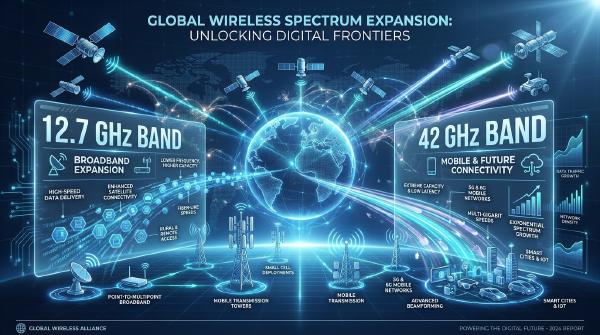
Wireless spectrum is a finite resource used to transmit information over radio waves. Different frequency bands have different propagation characteristics and are suitable for different network architectures.
Low-band spectrum around 800 MHz generally offers better coverage over long distances and improved penetration through many common building materials compared with higher-frequency spectrum, although actual performance depends on signal strength, construction materials, antenna design, and other conditions.
SpaceX intends to combine this low-band spectrum with its existing spectrum resources and satellite network.
According to SpaceX’s announcement, its 2 GHz spectrum will provide a higher-capacity layer, while the newly announced low-band spectrum is intended to provide a broader coverage layer.
The combination could support a hybrid network that uses satellites and terrestrial infrastructure to connect compatible mobile devices.
What the spectrum portfolio provides #
| Capability | Potential contribution |
|---|---|
| Low-band wireless spectrum | Broader coverage and improved propagation through many obstacles |
| Existing 2 GHz spectrum | Additional capacity for satellite-to-device services |
| Starlink satellite constellation | Connectivity in remote areas and locations without reliable terrestrial service |
| Terrestrial network infrastructure | Additional capacity and connectivity in populated areas |
| Compatible smartphones | Access to supported services without necessarily requiring a dedicated satellite handset |
The final column of the architecture remains particularly important. Owning spectrum does not automatically make every smartphone compatible with a new service. Device band support, network configuration, regulatory authorization, and the operator’s deployment plans determine actual compatibility.
📡 From Satellite Internet to a Hybrid Mobile Network #
Starlink initially built its business around satellite broadband, using user terminals to connect households, businesses, maritime customers, and other users to satellites in low Earth orbit.
Its direct-to-device strategy expands this model by allowing compatible mobile devices to communicate with satellites without requiring conventional dedicated broadband terminals.
The new spectrum agreement represents a further expansion of that strategy.
The limitations of satellite-only mobile connectivity #
Satellite-to-phone communications offer a way to extend coverage beyond conventional cellular networks. However, available capacity and signal conditions present technical challenges.
A satellite is serving users over a much larger area than a typical terrestrial cell. Radio resources must therefore be shared among customers spread across that coverage region.
Buildings, trees, terrain, and other obstructions can also weaken satellite signals. In crowded urban areas, high user density creates additional capacity demands.
A low-band terrestrial network can help address some of these limitations because ground-based transmitters operate closer to users and can reuse spectrum across multiple geographic cells.
The proposed hybrid architecture #
SpaceX’s plan combines satellite connectivity with terrestrial wireless deployment rather than relying on satellites alone.
In such an architecture, satellites can provide broad-area connectivity, while terrestrial equipment can help deliver service where population density, indoor coverage, or traffic demand makes ground infrastructure valuable.
Potential benefits include:
- Better coverage in rural areas and cellular dead zones.
- Additional connectivity options during natural disasters or network outages.
- More flexibility in serving compatible devices across different environments.
- The possibility of combining broad satellite coverage with denser terrestrial capacity.
However, a truly comprehensive national mobile network requires more than acquiring spectrum and deploying satellites. SpaceX will also need appropriate authorizations, compatible devices, network management systems, and an effective terrestrial deployment strategy.
The spectrum deal therefore represents a major strategic step, not proof that seamless nationwide service is already available.
🛰️ FCC Approval for 15,000 Starlink Mobile Satellites #
The spectrum announcement followed another important regulatory milestone.
In October 2026, the FCC approved SpaceX’s application to deploy a constellation of 15,000 satellites supporting direct-to-device services and associated satellite operations.
The authorization provides a framework for SpaceX to expand its satellite-to-mobile infrastructure. The system is intended to support mobile satellite services and supplemental connectivity using relevant satellite and terrestrial spectrum arrangements, subject to the conditions of the authorization.
The Commission’s approval is a significant step toward allowing Starlink Mobile to develop a larger-scale network for compatible devices.
How additional satellites could improve the service #
A larger constellation can increase the number of satellites available to serve a region and provide more opportunities to allocate capacity across the network.
SpaceX says its next-generation satellites will deliver substantially greater bandwidth than the current generation. The resulting performance will depend on the satellites’ final capabilities, available spectrum, ground infrastructure, and network deployment.
Important factors include:
- Satellite capacity: How much traffic each satellite can support.
- Spectrum utilization: How efficiently radio resources are allocated among users.
- Coverage and handovers: How devices transition between satellites and terrestrial network components.
- Ground infrastructure: The availability of gateways, routing facilities, and terrestrial equipment.
- Regulatory compliance: Adherence to spectrum conditions, interference protections, and orbital authorization requirements.
The FCC authorization does not mean all 15,000 satellites are already deployed or operational. Deployment will occur over time and remains subject to the relevant regulatory and engineering requirements.
📱 Can Starlink Mobile Compete with AT&T, Verizon, and T-Mobile? #
SpaceX’s spectrum strategy points toward a more direct challenge to traditional U.S. mobile operators.
AT&T, Verizon, and T-Mobile operate extensive terrestrial networks using licensed spectrum, cell sites, backhaul connections, and supporting infrastructure. SpaceX’s competitive proposition is different: it combines space-based connectivity with plans for terrestrial wireless operations.
The 800 MHz acquisition could give Starlink Mobile an additional coverage layer that complements its existing satellite capabilities.
How the competitive landscape could change #
A hybrid satellite-terrestrial network could be attractive to customers who regularly travel through rural or remote areas, experience cellular dead zones, or need an alternative communications path during emergencies.
However, competing with established operators nationally is a much larger undertaking.
Traditional carriers already have extensive networks and established customer relationships. SpaceX will need to demonstrate competitive service quality, practical device compatibility, pricing, customer support, and sufficient capacity in high-demand areas.
The role of spectrum ownership #
Spectrum is a valuable resource because it can enable an operator to control more of its network’s capacity, coverage, and deployment strategy.
For SpaceX, acquiring low-band licenses could reduce some of its dependence on arrangements with existing terrestrial carriers for particular types of service. It could also provide greater flexibility in building a network that combines satellite and ground-based links.
Nevertheless, spectrum ownership alone does not guarantee network performance or commercial success. The economics of terrestrial deployment, equipment costs, regulatory obligations, and customer demand will remain decisive.
📉 Market Reaction: Telecom Stocks Face New Competitive Pressure #
The announcement quickly attracted financial-market attention.
Reuters reported that AT&T, Verizon, and T-Mobile shares fell by around 6% in response to the news, while SpaceX’s private-market valuation shares reportedly gained ground in secondary trading.
These initial movements suggest that investors viewed the spectrum transaction as strategically important for the telecommunications industry.
Why investors reacted #
The potential entry of a major satellite operator into the conventional mobile market raises several questions for established carriers.
Could Starlink Mobile compete for customers who prioritize coverage over wide geographic areas? Might a hybrid network offer an attractive alternative to conventional cellular service in certain regions? Could SpaceX’s control over satellite capacity and wireless spectrum influence future pricing and partnerships?
These possibilities may influence investor expectations even before the new service becomes widely available.
However, short-term market moves should not be mistaken for proof of the transaction’s eventual commercial impact. Stock prices can react to expectations, trading conditions, and broader market developments as well as the underlying business fundamentals.
What will matter over the long term #
The more important indicators will be the network’s actual capabilities and commercial results:
- Spectrum acquisition closing and regulatory approvals.
- Satellite deployment and service-launch timelines.
- Availability of compatible smartphones and network equipment.
- Service coverage, capacity, latency, and reliability.
- Customer adoption, pricing, and retention.
- Capital expenditure and the cost of terrestrial infrastructure.
Until those factors become clearer, the deal is best understood as a significant strategic move with substantial execution requirements.
🚀 Musk’s Broader Ambition: Combining Space, AI, and Connectivity #
Following the ceremony, Musk publicly celebrated the other award recipients. SpaceX also announced its spectrum agreement, and Musk described the development as a major milestone for the company’s mobile strategy.
His comments reflected a broader ambition to combine satellite infrastructure, artificial intelligence, advanced manufacturing, and wireless communications.
These businesses are increasingly connected. Large AI systems require data centers and robust networks, while satellite operations depend on sophisticated software, computing, communications, and manufacturing capabilities.
SpaceX’s expanding communications infrastructure could create opportunities for new services, but the commercial outcome will depend on whether the company can deploy reliable systems at competitive cost.
Why the spectrum announcement is strategically important #
The agreement could give SpaceX greater control over another component of the wireless connectivity stack.
Rather than relying only on satellite capacity or partnering with conventional mobile carriers, the company aims to combine its satellite constellation with additional terrestrial spectrum and infrastructure.
That approach could make Starlink Mobile more versatile, especially in environments where satellite connectivity alone has limitations.
The challenge is execution. Building a network that can serve remote communities, indoor users, and densely populated areas requires different coverage and capacity solutions. Balancing them will determine how effectively the new spectrum can be translated into a compelling consumer service.
🔍 Conclusion: An Award Ceremony and a Major Telecommunications Milestone #
Trump’s October 8, 2026 presentation of the National Medal of Science to Musk recognized a series of ambitious engineering projects across space exploration, communications, intelligent systems, and manufacturing. The ceremony also honored prominent leaders from the semiconductor, computing, and digital-platform industries.
At the same time, SpaceX’s agreement to acquire up to 14 MHz of paired 800 MHz spectrum marked a potentially important step in Starlink Mobile’s evolution.
Combining low-band wireless spectrum with existing 2 GHz spectrum, satellite infrastructure, and terrestrial deployment could help SpaceX expand beyond conventional satellite broadband and direct-to-device connectivity.
But the distinction between strategic ambition and operational reality remains important. The acquisition still requires final regulatory approval, and a national mobile service will require additional infrastructure, compatible devices, network optimization, and substantial investment.
For the telecommunications industry, the development signals that satellite operators may increasingly compete across multiple layers of connectivity. For consumers, it creates the possibility of broader coverage and new service options.
Whether Starlink Mobile becomes a major nationwide carrier will ultimately depend on execution, economics, and real-world network performance—not the spectrum deal alone.